

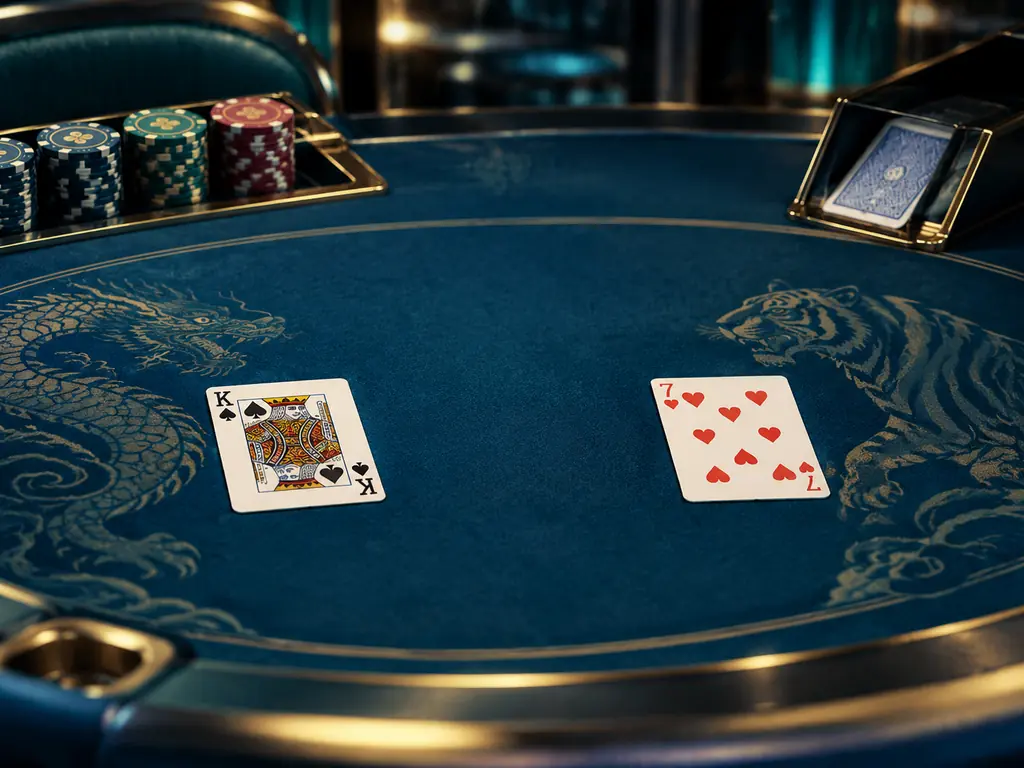
Understanding Dragon Tiger results on 1111bet
Dragon Tiger’s card comparison and the monetary settlement of each selection answer separate questions. This detailed 1111bet explanation follows card rank first, side-bet conditions next, then the process of matching a result to the accepted-selection record.
A single card’s rank determines the comparison
The rank order is A, 2, 3, 4, 5, 6, 7, 8, 9, 10, J, Q, K. In that order, Q is above J but below K. If Dragon has K and Tiger has A, the K side has the higher rank. An A being high in another game is not a reason to move it to the top of this order.
Different suits do not change which card has the higher rank. Nor is the result calculated by adding the two cards, retaining a final digit or anticipating a third card. This single-card comparison is what distinguishes Dragon Tiger from Baccarat’s hand-total calculation.
Separate the main result from side-bet conditions
When Dragon and Tiger have equal ranks, the card result can be identified as a tie. That does not mean every type of selection is paid in the same way. Tie and Suited Tie are separate side bets. Their payout ratios do not explain how a main Dragon or Tiger selection is settled on a tie.
Evolution’s published description specifies 11:1 for the ordinary Tie side bet on equal ranks irrespective of suit, and 50:1 for Suited Tie on matching rank and suit. This 1111bet introduction keeps each ratio attached to its own name. Cards meeting a condition do not automatically create a side-bet selection that was never active.
| Point to compare | Ordinary Tie | Suited Tie |
|---|---|---|
| Card rank | Both ranks are equal | Both ranks are equal |
| Suit | Suits can match or differ | Both suits must match |
| 7♥ and 7♠ | Meets the ordinary tie condition | Does not meet the matching-suit condition |
| Published side-bet payout | 11:1 | 50:1 |
| Check before calculating | Whether the Tie selection was active | Whether the Suited Tie selection was active |
A complete card-comparison example
This hypothetical situation explains a result; it is not a record of actual play. Suppose a participant’s Dragon selection was accepted before entries closed. Dragon then receives Q♣ and Tiger receives 10♦. Q ranks above 10, so Dragon is the higher-ranked side in this situation. The result does not come from the colours of clubs and diamonds.
If both positions had instead received Q, the card result would be a tie and the ordinary higher-side condition would no longer be met. The accepted selection and its tie-settlement rule would then need checking. Neither assuming a Tie side bet from a main selection nor applying 50:1 follows merely from seeing a Q.
- Confirm that the selection was accepted on Dragon and identify the corresponding round. An assumed touch is not a substitute for its record.
- After selection closes, identify Q♣ in the Dragon position and 10♦ in the Tiger position. Reversing the positions would produce the wrong interpretation of the same cards.
- Compare Q and 10 using the stated rank order and identify Dragon as higher. Do not use suit as an additional tiebreaker or convert the cards into a points total.
- After confirmation, match the result to the accepted selection’s settlement. If the amount differs, use the round identifier, selection and revealed-card details to ask the service concerned for an explanation.
Differences from Baccarat and Crazy Time
Baccarat is a useful comparison in 1111bet’s live-table discussion. Its assigned card points are added and the final digit of the hand total is used; further cards may be drawn under the applicable rules. In Dragon Tiger, Q retains its position in the rank order. Bringing Baccarat’s zero-point treatment into this game would wrongly make Q and 10 equal.
Evolution’s Crazy Time is instead a wheel-based game show, where a main result can open a separate bonus stage. Dragon Tiger’s ordinary two-card rank comparison has no such bonus wheel or personal hidden grid. Similar live presentation does not mean that additional choice periods, finishing signals or relevant records are the same.
Current table rules and uncertain records
A name or familiar image cannot establish the full rules. Match the complete title, Evolution identity, names of the main and side-bet selections, and the current table’s payout explanation. In particular, do not transfer another version’s treatment of ties on main bets, limits or card-set arrangements.
After using the 1111bet explanation to understand the result, check both cards, their positions, the selection type and the confirmed outcome together when a round is uncertain. A delayed video alone does not establish a second selection or changed result. A history chart arranges past events; it does not guarantee the next card or provide a method of recovering losses.
- Keep the full game and table names, current rules and separate identities of the main and side-bet selections.
- Record the time and time zone, round identifier and confirmed state of the personal selection.
- Identify the Dragon and Tiger cards separately, keeping rank and suit details distinct.
- For a settlement discrepancy, use the service’s relevant record when asking for an explanation. Do not send passwords, verification codes or complete payment details.